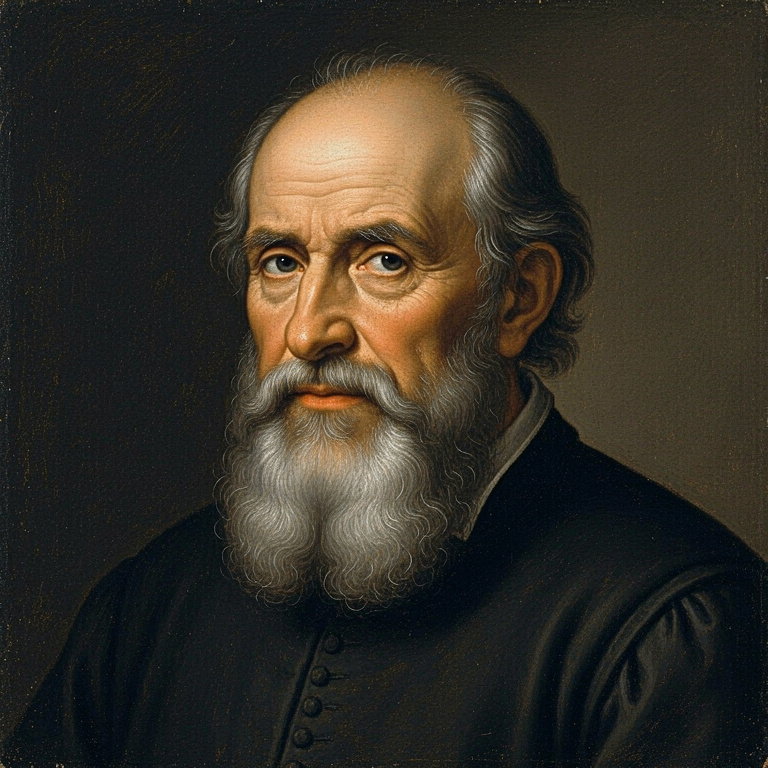
Galileo Galilei
1564–1642
Astronomer and physicist who turned the telescope on the sky and insisted that nature is written in mathematics. A champion of evidence over inherited authority.
Learning paths
Story so far
- 1564personal
Born in Pisa
- 1581work
Discovers pendulum isochronism
- 1589work
Chair of Mathematics at Pisa
- 1592work
Moves to University of Padua
- 1609work
Builds improved telescope
- 1610highlight
Publishes Sidereus Nuncius
- 1615controversy
Roman Inquisition investigates heliocentrism
- 1632controversy
Publishes Dialogue Concerning the Two Chief World Systems
- 1633controversy
Tried and condemned by Inquisition
- 1634personal
Death of daughter Maria Celeste
- 1638work
Publishes Two New Sciences
- 1642death
Death in Arcetri
Life chapters will appear here once the autobiography track is generated.
Posts
Dialogue · Ship thought experiment
Drop a ball on a ship sailing smoothly and it falls as if the harbor were still. Uniform motion hides itself. That insight is not yet Einstein—but it opens the door: what you call 'at rest' may already be a choice of frame.
Brain spark · Spot the flaw
Listen to this argument. Where does it crack?
1633 — trial
1633: the trial. The conflict was real; the cartoon version is too neat. What endures is the method: look, measure, publish, let the heavens answer. Authority can delay a truth. It cannot forever outlaw a telescope.
Math as language
Philosophy is written in this grand book — the universe — but it cannot be understood unless one first learns the language: mathematics. Argument without measure is theater. Measure without curiosity is accounting.
Falling bodies
In a vacuum, a feather and a hammer argue less than your intuition expects — they fall together. Air is the busybody. Gravity, left alone, does not play favorites by weight the way folklore claims.
1610 — Sidereus Nuncius
I turned a spyglass on the night and found moons around Jupiter — worlds that do not circle us. The sky is not a painted ceiling for human vanity. It is a place with its own traffic.